A debris disk is an extensive band of solid particles orbiting a star, something like Saturn's rings or a levelled-up version of our own asteroid belt. Because of the numerous particles present that can in some cases escape the star's gravity, debris disks are good candidate sources of interstellar material that could reach our Solar System.
A study by Gregg & Wiegert at the University of Western Ontario in Canada showed that material across a range of sizes up to 100 meters across could already be present in our Solar system after having travelled to us from the 20 closest debris disks. This work was published in a 2026 paper in the Planetary Science Journal, and examines the possibility that solid particles from these nearby systems reaching us after being ejected from their origin disks by naturally-occuring gravitational slingshots. A pre-publication version of the paper is available at here on Arxiv, and the full open-access published version is here at the Planetary Science Journal or here.
If nearby debris disks are ejecting material at a rate consistent with expectations, Gregg & Wiegert found that there may be roughly two asteroids of 100 meter size currently within telescopic range; that is, within about 10 times the Earth's distance from the Sun, which marks the practical distance at which objects this size can be seen with current telescopes. There may also be 10 meteors (shooting stars which flare when a particle hits our atmosphere) visible to the human eye which reach the Earth every year, and thousands that could be detected with more sensitive meteor radars. The asteroids will hopefully be detected when larger asteroid surveys like the Legacy Survey of Space and Time (LSST) begin operating at full capacity. The meteors will hopefully be detected with continued operations, expansion and improvements of the Global Meteor Network and
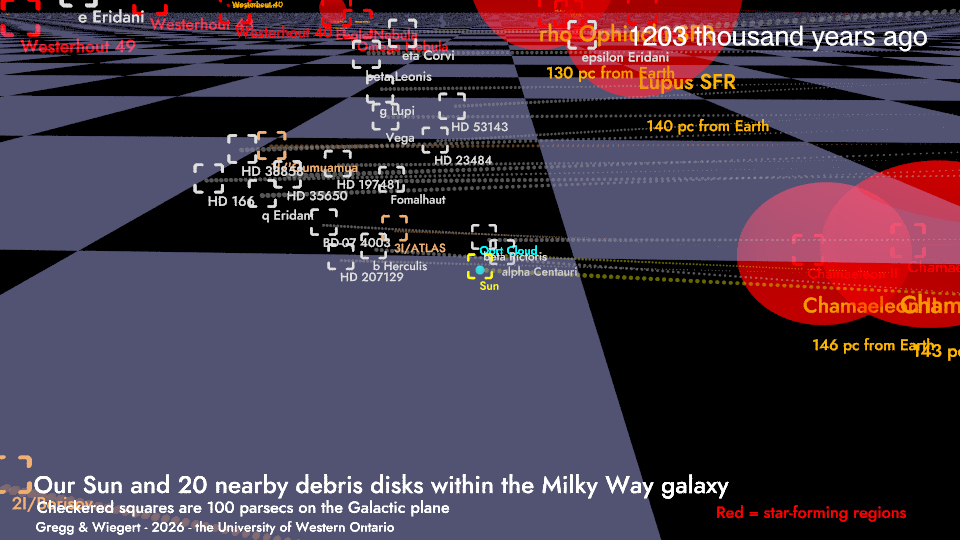
Video illustrations of our Sun and these debris disks within our Milky Way
If we could watch our Sun travel through our Galaxy for the last few million years, what would its path look like? This animations show us what we would see if we could watch them from a spaceship speeding along with them. Click on the illustration below to see a version of the animation on YouTube.
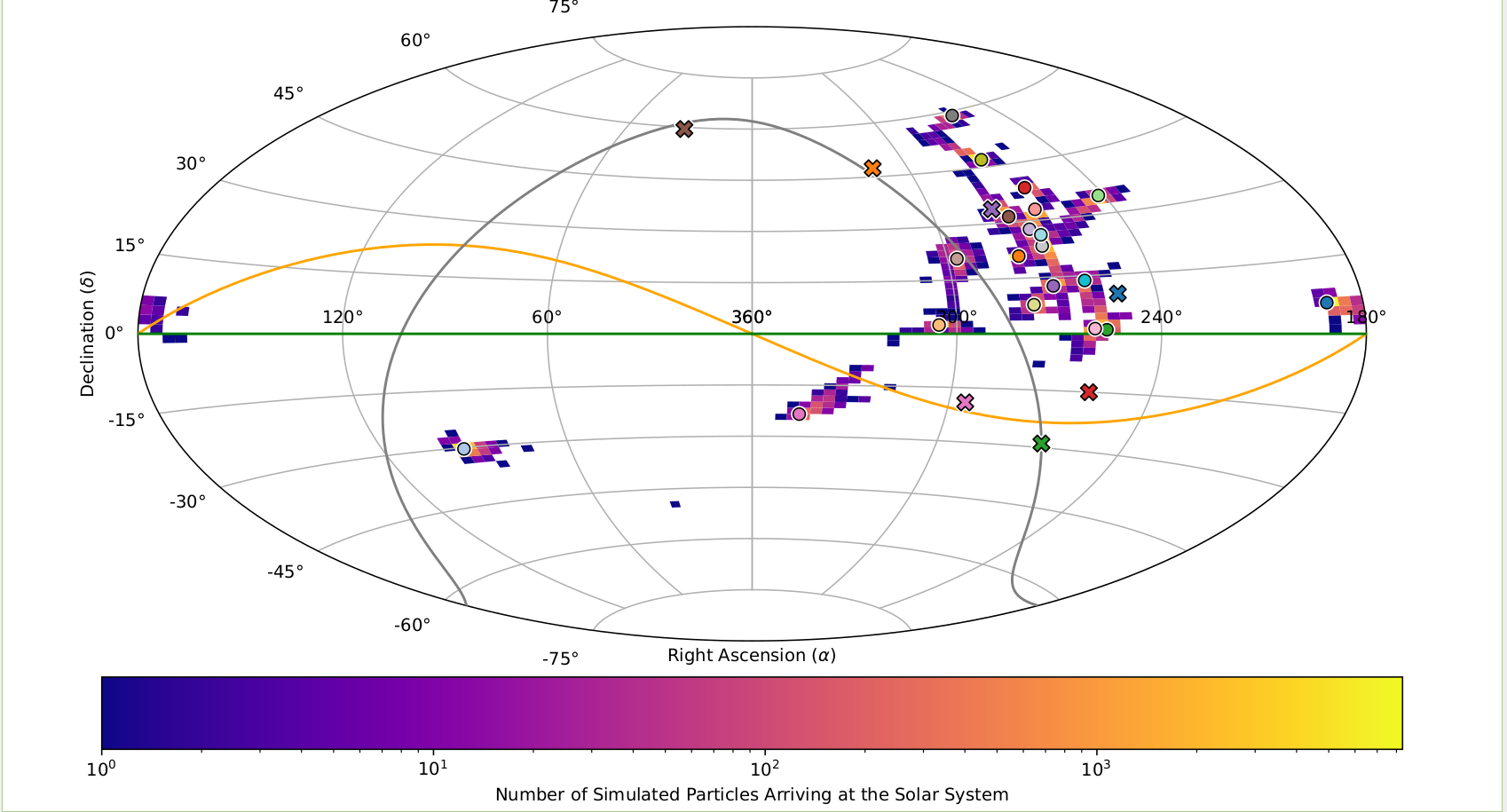
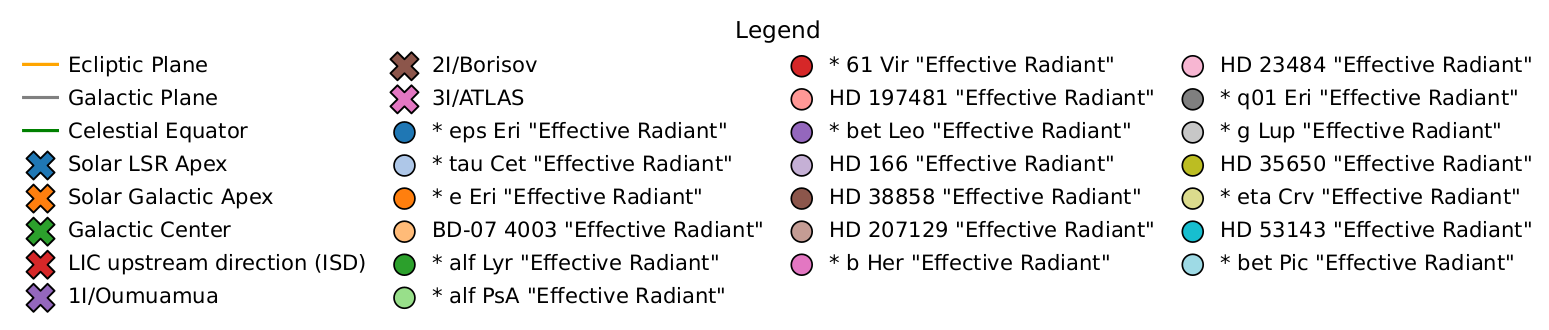
If we see an asteroid or meteor, how can we tell if it is from alpha Centauri? In our study we showed that objects from each debris disk arrive from very specific directions, which should make identifying them much easier. The arrival directions on a projection of the whole sky are shown below.
Related links
Have a question or comment? Contact me (Paul Wiegert at pwiegert[the @ sign]uwo.ca)